

Louvre width, honestly: 63, 89 or 114 mm
Blade width is the most-asked and least-explained choice in shutters. It is not a style tax or a price lever; it is a genuine trade between light, view, privacy and proportion.
What actually changes with width
Every blade in a panel casts a shadow and blocks a slice of view when tilted. Wider blades mean fewer of them in the same opening: fewer edges across your view when open, deeper shade per degree of tilt, and a bolder, more architectural look. Narrower blades mean finer control and finer lines: more edges, but each one smaller, and a scale that suits smaller windows. Neither is better; they are tuned for different windows.
| Trait | 63 mm | 89 mm | 114 mm |
|---|---|---|---|
| Best on | Small windows, wet areas, cottage panes | Most windows; the versatile middle | Big glass, stackers, view windows |
| View through, blades open | Most edges in the sight line | Balanced | Fewest edges, most view |
| Shade per degree of tilt | Shallowest | Middle | Deepest; reaches no-glare with least tilt |
| Privacy grain | Finest control | Fine | Coarser; big blades move more per step |
| Look | Traditional, delicate | Quietly either | Modern, architectural |
| Proportion risk | Fussy on huge glass | Rarely wrong | Chunky on small panes |
Our defaults, and why they bend
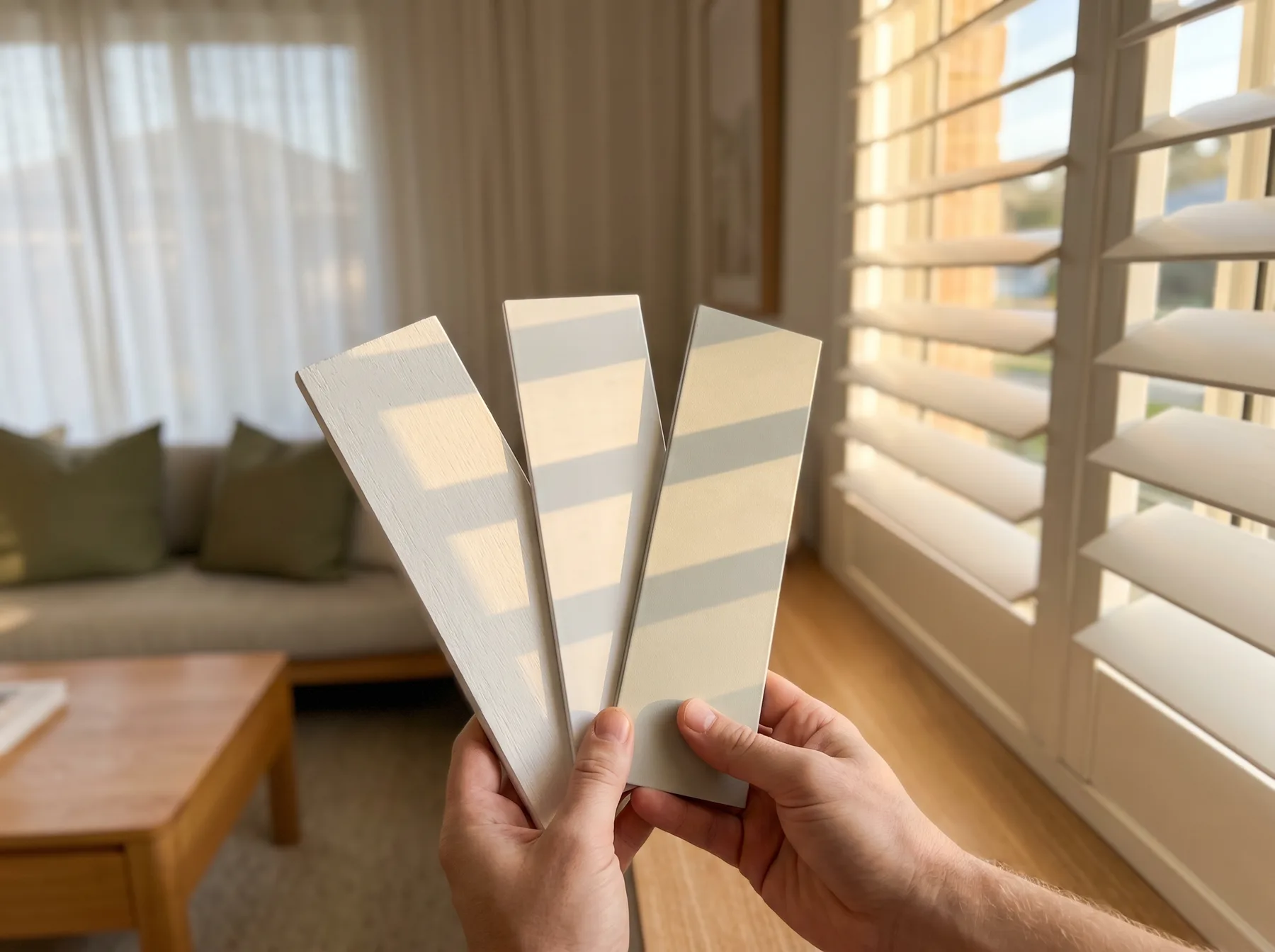
On a Maitland measure we start most rooms at 89 mm, push west-facing living glass toward 114 mm for the shade-per-tilt advantage, and pull wet areas and small period panes toward 63 mm where the window's scale asks for it. Then the room argues back: a heritage sitting room with tall sash might carry 89 mm beautifully where the maths said 114, because proportion outranks physics in a room you look at every day. This is exactly the kind of call that gets made with sample blades held up in your actual window, which is what the free measure is for.
One habit worth more than the width
Whichever blade you choose, learn its late-afternoon angle. Tilted up toward the sky, any of the three widths will put a west room's glare back outside while the light stays; the wide blade just gets there with less tilt. Try it on the 5pm Test's live window and watch what the angle does.
Book a free measure, samples includedFree in-home measure & quote
The measure is free. The advice comes with it.
Every window here is made to measure, so an accurate price only exists after we have seen your windows and your light. Tell us about the rooms you are thinking about and we will arrange a time, measure each opening, and leave you with a written quote and a straight recommendation. No obligation either way.